5 Key Considerations for South Florida Startups Seeking Funding

This post was originally posted in the Miami Herald and can be viewed here

Since we opened our Miami office in the fall of 2014, thus becoming the first institutional venture capital firm in the MagicCity, we’ve met with countless South Florida startups and are incredibly encouraged by the activity we see in the ecosystem. There are plenty of driven entrepreneurs as well as helpful organizations such as eMerge Americas, Knight Foundation, Rokk3r Labs,Wyncode and Carve Communications, all of which provide much needed support to the growing landscape. Needless to say, we are thrilled to be a part of this budding ecosystem, and intend to help entrepreneurs reach their potential.

That being said, after talking with many entrepreneurs over the past 10 months, there are some key aspects to raising capital that founders should be mindful of as they set out on the fundraising trail. Keep in mind the following are not ranked in any particular order of importance:

1. Team and Culture: Many founders believe their product is the most important asset, but at Scout, we look first and foremost at the team and the culture of the company in question. We examine the background of the team, and discuss how these contribute to what the entrepreneur and team are specifically working on. We also explore how the team is structured. At Scout, we make sure every team member has a clear job and is well suited to handle it. We also look to see if a founding team has both a technical and non-technical co-founder, as we have found that this often contributes to a successful team dynamic.

2. Roadmap and Timeline: As investors, we like to know what you’ve built and accomplished since the inception of your business. But at Scout, we are just as interested in what you’re planning on doing next. As an entrepreneur, you should be able to confidently and succinctly discuss items such as: the benchmarks and KPIs that your business needs to hit, your product roadmap, who your key hires will be and when you plan on hiring them. If your company is sales-driven, be able to discuss who your target customer is and the typical sales cycle associated with your business. Understanding the future path to success is even more important than the path you took to get a meeting with an investor. Entrepreneurs should be thinking about revenue milestones, key hires, sales pipeline and the key performance indicators that are going to drive your business to the next level.

3. Product: As an entrepreneur, there are many distractions that you can get caught up in, including fundraising. While it is easy to get lost in the noise, successful entrepreneurs will be able multitask fundraising and building the product and sales pipeline. Of course, fundraising will take a good chunk of your time, but effective leaders delegate efficiently. Thus, we like to see teams who continue to improve their product during the fundraising process. We see that as a positive signal that teams will be able to successfully iterate on their product over the long run, even with the inevitable distractions that a startup will encounter over its life.

4. Revenue: At Scout we are revenue focused because we aim to build sustainable companies that have a clear path to monetization. Although there are many VC firms that tend to invest in companies that focus on user growth before monetization, we do not subscribe to that mindset. As a result, we ask our entrepreneurs to have realistic revenue models as well as plans to achieve those revenue targets. These plans will not just please your investors, but they will set you up for long-term success, making your life much easier down the road.

5. Reporting: Although reporting can feel like an onerous task, it is a crucial aspect of your business. We’ve found a natural correlation between efficient reporting practices and successful startups. A company report should be sent to investors on a monthly basis and should include metrics such as monthly revenue, cash on hand, monthly burn, and other relevant KPIs. Founders should give these metrics context by describing how the business has evolved over the past month, and by giving any relevant news updates. Finally, founders should outline where they expect the company to be in the next month, and ask investors for any assistance reaching these goals

Hopefully, these tips are helpful to all the entrepreneurs based in Miami.  We’re very excited to be here, and we believe South Florida is on the verge of becoming a household name in the tech-ecosystem. Over the past year, we have seen local entrepreneurs make meaningful strides, and we believe the space will generate strong returns not only for us, but for any investors who are starting to build a thoughtful,strategic allocation to venture capital.

5 Key Considerations for South Florida Startups Seeking Funding

MAKING THE FOUNDER’S TOP FIVE

This article was originally posted by Brad Harrison on August 5, 2015. The original can be viewed here.

Yesterday morning I read a blog post from a colleague, Hunter Walk, where he talks about competition in the seed stage. Essentially, he concludes that seed stage investors should focus on seeing great deals and being in the founder’s Top Five. It’s something we firmly believe in here at Scout. And every summer, when the office is full of fresh minds with new team members and interns, we spend our time talking about how we make ourselves more valuable to founders. How can we leverage our relationships and operational experience to help alleviate their pain points so they can focus on building a great company?

And as we continue to grow our portfolio, now 58 strong, I realize more and more, that our focus after we make an investment needs to be on helping our founders execute on their vision. This means a few things:

(1) Capital: If the business is consistently under capitalized then the founder will always be distracted by fundraising. The more you can provide leadership pulling together a round and/or making introductions to investors, the more you’re delivering real value. It also doesn’t hurt to make sure they raise enough money.

(2) Stress Management: Being a founder can be lonely and very stressful. At Scout, this means “being present” for your founders. It’s important to let them know they are not alone and that you understand how difficult some of their decisions will be around product, technology and personnel. The more you can share personal experiences to help them think through some of these difficult decisions, the more valuable you can be.

(3) Operations: Most great founders are not focused on operations, so they need help. If you provide advice, guidance and service providers, you will enable them to focus on building their business.  A great founder needs a great team – so help them recruit people on the operations side to give them the confidence to focus on other areas of the business.

Of course, we realize that many founders will fail; some founders will have an exit; some of these founders might even make money on the exit, and a few founders will build unicorns and become investors. But by helping founders execute, we like to think we are helping more and more founders and companies reach their full potential.

MAKING THE FOUNDER’S TOP FIVE

How I Make Sure Work Doesn’t Ruin My Vacation

Scout Ventures's avatarBe Happy

Here’s the scenario: you have a vacation coming up in two weeks. You should be looking forward to it, imagining yourself letting stress melt away under the sun or on the slopes, but all you can think about is the work that will pile up while you’re away. You might even feel like skipping the vacation just to save from all of the stress that comes with leaving the office. But we all need a vacation sometimes, it just takes some minor, but strategic planning to get you in a vacation state of mind.

I thought about writing this post because, as I type, I am on my annual family getaway in Wellfleet on Cape Cod and although I am periodically checking my email, I am getting some much needed relaxation and quality time with my kids. Whether you are an executive or an intern, I thought sharing my own tips could…

View original post 511 more words

How I Make Sure Work Doesn’t Ruin My Vacation

Do Smaller Funds Perform Better?

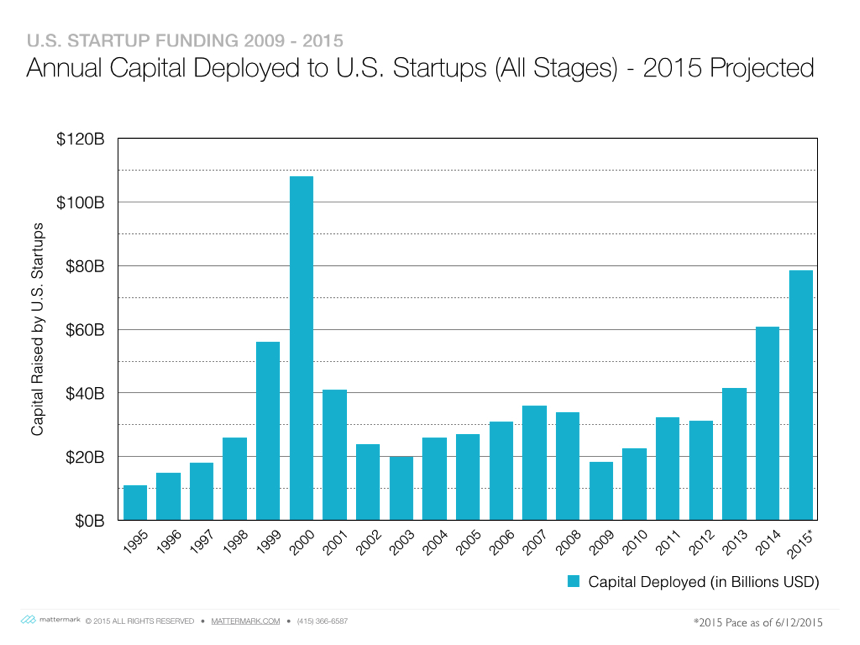
In a report recently released from Mattermark, it is indicated that investment in startups from 2014 to probable year-end 2015 will eclipse all prior years, except for 2000. Now, ‘Unicorns’ are all the rage, leading many VC firms to raise bigger funds to target larger and later stage investments. But in the world of Venture Capital, bigger is not always better.

pic1blog6-23

A 2012 study by the Kaufman Foundation noted that in the years between 1997 and 2009, “only four of thirty venture capital funds with committed capital of more than $400 million delivered returns better than those available from a publicly traded small cap common stock index.” The solution, they propose, is to invest in smaller funds. In the study, Kaufman provides a number of reasons for this proposed realignment of investment allocations, the most notable being that smaller funds make their money from fund performance whereas larger funds tend to make money via fees. This pay-for-performance model makes sense intuitively, but is also far from a complete understanding of what is actually happening within the Venture Capital space.

Let’s try to break it down:

Smaller Funds have to return less capital

When a typical LP investor contributes to a late stage VC fund, they are probably doing so with an expectation to make three to five times their investment in total returns. On a $500 million fund, this means investors are likely targeting $1.5 billion – $2.5 billion in distributions at the end of the fund’s life. There’s a lot that has to go right in order to accumulate that much cash.

Small Funds don’t compete in the run-up in valuations

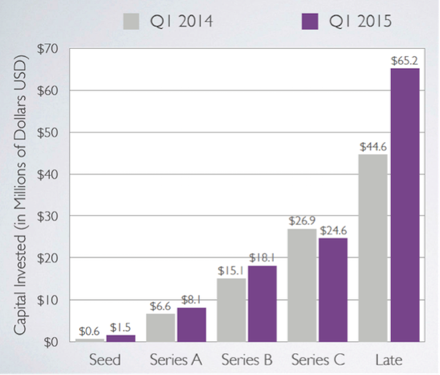
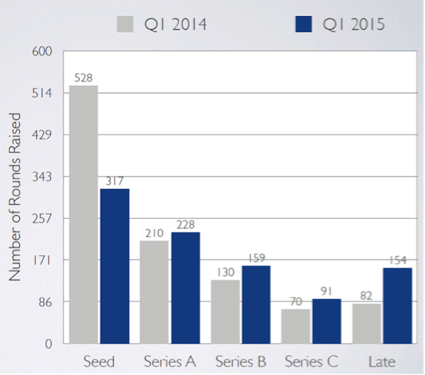
In the above case, the firm cannot realistically get all their money out the door by writing checks in $1 million increments; their ability to source enough quality deal flow and their ability to effectively monitor existing investments doesn’t scale that easily. They end up making large bets on relatively fewer later stage companies, effectively increasing their unsystematic risk which investment theory says they should diversify away. Compare the two charts below to see that Seed Investors make more investments but at very low average check sizes. This improves their risk return profile since they’re less reliant on one big winner.

Average Deal Size by Stage vs. Deal Volume

           pic2 pic3

You can clearly see above that in later rounds, relatively fewer numbers of deals are getting the majority of the funds. Jason Lemkin at SaaStr estimates as much as “75% of invested capital [is] trapped in private Unicorns,” indicating investors are increasingly driving up valuations of promising later stage rounds which Small Funds simply don’t get involved in.

Smaller Funds are company builders, not just company backers

Investing in a $1 billion Unicorn means investing in a company that is already performing well, firing on all cylinders and looking to scale quickly. In contrast, investing in a $10 million company means investing in a company that is looking to make one of its first few hires, even its first sales-person, which implies they’re preparing for, but haven’t actually experienced yet, a product-market-fit. In both cases, the investor is providing capital as a value-add, but in earlier stage investing – where Small Funds predominate – the investors are often also adding much needed outside support of a more intangible nature. Oftentimes, this comes in the form of the first outside board member, able to provide much needed guidance for best-practices to technical founders with minimal business experience, or plugging the startup into a larger network full of future investors, potential advisors and even customers – all of which the startup may have failed without.

Big funds may also provide these services – a16z is famous for it – but on the whole, they are more focused on getting dollars out the door rather than nurturing budding entrepreneurs through their growing pains and company pivots. By the time a smaller fund has shepherded a company through these early stages, they have effectively helped de-risk the investment, thereby making it an attractive target to a larger fund in a much more sizable subsequent round of financing. As an existing investor, Smaller Funds can participate in these follow-on rounds which helps improve Small Fund returns by concentrating capital in their all-stars. By doing this, Small Funds magnify the impact of outperformers on the fund’s overall performance in a way less available to Large Funds, who are participating in in the last few rounds of financing prior to an IPO or eventual sale.

Early investing is not without risks

We would be remiss if we didn’t point out the other side of the coin here. Investing in unproven companies means you are investing without the benefit of past performance and the failure rate among early stage companies is notoriously high. Furthermore the risk of dilution by inflated rounds of financing in Series A and beyond is something investors must be very cognizant of and should take steps to insulate themselves against this risk. Doubling down on winners is one of many ways to do this and many early stage investors would be wise to allocate a large proportion of their fund to follow-on investments. With all that said, investing in early stage companies can provide better cash-on-cash returns, provided you have the stomach for it.

Do Smaller Funds Perform Better?

Guest Post: Investing in Mini IPOs

This articled was originally posted at Inc.  You can follow Ryan Feit on Twitter.

Historically, investing in startups and small businesses has been reserved for accredited investors, or just the wealthiest 2% of Americans. Now, after three years of anticipation, investing in pre-IPO companies will be opened up to the other 98%. Title IV of the JOBS Act which kicks on Friday, June 19th enables the fastest growing private companies in America to conduct Mini-IPOs and raise up to $50 million from everyone.

Although these sweeping changes hold enormous potential, the investment options for retail investors will initially be limited and will not open all private investment opportunities to all investors. Individual private companies which choose to conduct fundraises with all investors will need to prepare and file a registration statement with the SEC and receive SEC approval prior to launching a Mini-IPO.

There are a few points which new potential investors should keep in mind as they begin to explore this new asset class:

1. Testing the Waters

In most cases, companies will “test the waters” prior to undergoing the full SEC registration process. This means that companies will start talking to investors, marketing the opportunity, and collecting “Indications of Interest.” Essentially companies will solicit expressions of interest from potential investors and to determine whether investors are interested before they spend time and money pursuing a full-blown Mini-IPO. You should be aware that these “Indications of Interest” are non-binding and do not compel you to make a future investment.

2. Investment

For new investors, there will be a cap on the amount you can invest, generally up to the greater of 10% of your annual income or net worth. For example, if you make $75,000 of income per year with little savings, you will be able to invest up to $7,500 in a given opportunity. Regardless of the congressionally imposed investment limits, it’s not prudent for investors to allocate greater than 10% of their overall investment portfolios into private companies. Furthermore, as the old saying goes, “don’t put all your eggs in one basket.” Diversification is key, so make sure you are building a portfolio of at least 10 private companies.

3. Everyone Can Participate

This is the most meaningful change related to Regulation A+. Essentially all private companies which have raised capital up to this point have done so through a securities exemption called Regulation D, 506(b) which only permits accredited investors (ie. the wealthiest 2%) to participate. Although there are limits on what individual retail investors can invest, anyone in America will now be able to invest in private companies. As a reminder, companies will ultimately decide whether to open up to all investors, so investors will only have limited selection initially.

4. Unrestricted Shares

Unlike typical private investments, there are no restrictions on the resale of Regulation A securities so theoretically investors will be able to sell their shares the next day. That being said, in actuality, secondary markets for these securities are currently very limited. Eventually a robust secondary market will develop, but in the meantime, investors should plan on investing and holding for 5-7 years (until an acquisition or IPO occurs). Additionally, shares could also be subject to contractual transfer restrictions from the company itself. Pay careful attention to these transfer restrictions for any securities that you purchase.

5. The Nitty Gritty

Consult with your legal and tax advisors prior to making any investments so that you fully understand the terms of the offering. You should be wary of investing at a different valuation than institutional or larger investors investing around the same time. In addition, each company will be required to file a detailed disclosure document called a Form 1-A with the SEC. You should read this document thoroughly prior to making an investment. Finally, most Regulation A+ offerings will be conducted by broker-dealers, including those that operate online platforms like SeedInvest. You should do diligence on your broker-dealer and/or platform prior to making an investment through them.

This regulatory change marks a key development in the democratization of the private capital markets. 240 million Americans will now have the opportunity to enrich their portfolios of stocks and bonds by adding alternative assets, just like sophisticated institutional investors. However, with new opportunity comes new risks and it’s critical that new investors learn how to navigate this new asset class before taking the plunge.


Guest Post: Investing in Mini IPOs

Supply-Demand Curves In A Founder’s Fundraising Journey

Recently, a founder asked me if he should lower his valuation in order to close his seed round faster.  His valuation was already fairly typical for the seed market.  It sounds pretty intuitive and reminds us of our Econ 101 lectures from freshman year– as price decreases, demand increases.
However, a lot of things about startups and fundraising are counterintuitive and deserve a more careful look.  I’d include changing your valuation, which is the most thrown around number during a fundraise, on that list.
In a perfect market, a lower marketing clearing price means more demand.  Why doesn’t that work in venture?  Because there’s so much uncertainty in early stage tech, investors may read the action of a price reduction as a negative signal.
Negative signaling/externality  > Founder’s benefit from price decrease
A similar thing happens in real estate, where buyers start to raise questions about houses that are on the market for too long.  Tech investors will start to raise questions about whether something is “wrong” with your startup if you lower your valuation.
Here’s the unsatisfying part of this post: there’s really too many moving parts during a fundraise to really provide “one size fits all” feedback for this situation.  Every fundraise is different and you have to carefully craft a strategy around your context.  The only takeaway here is to just pay attention and try to stay ahead of any issues by staying well informed and by surrounding yourself with enough people who can give you good feedback.
Supply-Demand Curves In A Founder’s Fundraising Journey

Convertible Notes- The Phillips Screwdriver of Startup Financing Instruments

Contrary to what you might think, convertible notes have been around for a long time in early stage tech financing. What’s different today is that Y Combinator popularized it several years ago and since then, we’ve seen seed stage funding explode so these financial instruments have become pretty pervasive.

The problem these days is that there is lots of confusion and uncertainty when using them:

What percentage of the company am I buying?
What happens when you sell before a conversion event?
Does the note convert pre-money or post-money?

On the last question, see Brad Feld’s recent post:

We’ve been regularly running into another problem with doing a financing after companies have raised convertible notes. Most notes are ambiguous as to whether they convert on a pre-money or a post-money basis. This can be especially confusing, and ambiguous, when there are multiple price caps. There are also some law firms whose standard documents are purposefully ambiguous to give the entrepreneur theoretical negotiating flexibility in the first priced round.

With all this confusion, convertible notes seem like a pretty shitty de facto standard, if you ask me. Would you believe me if I told you things weren’t always this way? Once upon a time, there was more agreement and consistency when using convertible notes.

Here’s Seth Levine (Brad Feld’s partner) talking about convertibles converting pre-money in 2012:

The problem, of course, is that their convert is already a part of their capitalization – even though it’s not reflected on the cap table…

(in one case the entrepreneurs viewed the convert as a post equity deal event, meaning that they thought they were negotiating a round with us that would then layer on the debt conversion – exactly the opposite of how it actually works!).

When you raise $2M on a convert with a $6M cap you’ve sold 25% of your company (at least; 25% if this converts at the cap). And while your cap table may not yet reflect this in the numbers, your 40% founders equity stake is actually already 30% when you start the process of raising your equity round.

And here’s Babak Nivi on Venture Hacks (which leans founder friendly) saying the same thing (in a Youtube video on cap tables in 2008):

Your $6M pre-money valuation unfortunately includes the seed debt…

So we’ve gone from a time where we generally agreed to do something a certain way to a time where there’s lots of disagreement on how to do something.  It’s just a reality of where we are in this cycle and it’s a tough coordination problem to address with a market-based solution.

The complaints about notes are at an elevated level these days and there are a lot of investors who are shying away from them, for valid reasons (see Joanne Wilson).  However, we’re still seeing a lot of founders favoring them over equity or SAFE-style docs (and their choice is partly a function of what they think will work best for them in the fundraising marketplace).

De facto standards emerge when there is mutual gain in coordinating. When there’s a critical mass of founders, investors, and service providers using the same standards, it’s a beautiful thing (they are hard to establish and in my opinion, really under-appreciated!). But they are also difficult to replace when there’s something newer and better.

So just like the QWERTY keyboard, life goes on for convertible notes.  It may not be the perfect tool for pre-seed/seed stage financing, but it’s something that everyone in the game has in their toolbox.


Posted by John Ryu, Partner at Scout Ventures

Convertible Notes- The Phillips Screwdriver of Startup Financing Instruments

When the Tactic Becomes the Strategy

Historically, Google’s strategy was always aligned with an open web and Moore’s Law. As cheaper computing powered the growth of the open web, the value of Google increased.  Why? Because as web content growth explodes, tools to find the information that you’re searching for become more valuable. Things like Android and free wifi were tactics that leaned into this strategy.

Google ten years ago:

  • Core product/competency: Web Search
  • Strategy: Ride growth of open web
  • Tactics: Anything to increase the size of the web. Youtube, Gmail, Google Docs etc.
  • Competitors: Yahoo, Microsoft

As the players and ecosystems changed, the strategy had to change.  Fast forward a few years to when mobile started growing:

  • Core product/competency: Web Search
  • Strategy: Ride the growth of open web, now on mobile
  • Tactics: Android, Youtube, Gmail, bidding on spectrum
  • Competitors: Microsoft, Apple, Verizon Mobile

Here is Google VP Hiroshi Lockheimer supporting this:

via Farhad Manjoo at NYTimes:

“The bet that Larry, Sergey and Eric made at the time was that smartphones are going to be a thing, there’s going to be Internet on it, so let’s make sure there’s a great smartphone platform out there that people can use to, among other things, access Google services,” said Hiroshi Lockheimer, Google’s vice president for engineering for Android

However, mobile tossed a couple of curve balls. First, the future path of mobile began to look less about open platforms.  Instead, mobile was increasingly dominated by closed networks and siloed native apps. Second, we didn’t see a commoditization of smartphones due to the continuation of cheaper computing (maybe abroad but not in the US). How do you keep Google relevant in this paradigm? By making sure their previous forms of lock-in remain valuable to users.

  • Core product/competency: Cloud (Search, Youtube, Gmail, Docs, etc.)
  • Strategy: Ensure dominance of cloud and keep Google relevant
  • Tactics: Android
  • Competitors: Facebook, Apple

In the article linked above, Farhad Manjoo mentions that Google is making a lot of money selling apps now:

A brighter spot for Google is the revenue it collects from sales via Android’s app store, called Google Play. For years, Android apps were a backwater, but sales have picked up lately. In 2014, Google Play sold about $10 billion in apps, of which Google kept about $3 billion

And investing in tactics to grow:

Google is investing heavily to make sure that continues. Purnima Kochikar, business development director for Google Play, told me her team supporting Android app makers grew “by 15 times” in the last two and a half years.

It sounds like Google, in the span of several years, turned a tactic into a strategy:

  • Core product/competency: Android
  • Strategy: Ensure dominance of Android
  • Tactics: Increase app monetization
  • Competitors: Facebook, Apple

However, they are also facing powerful competitive pressure from companies such as Xiaomi and Cyanogen.

Android has always been a tricky strategy; now, after finding huge success, it seems only to be getting even trickier.

Nothing is clear in the fog of disruption but tricky strategies are better than those relying on hope.

Follow Scout Ventures on Twitter.

When the Tactic Becomes the Strategy

Guest Post: Is REG A+ Right For Fred Wilson’s “Indie” Companies?

This post was written by Kiran Lingam and originally appeared on the SeedInvest Blog

Not every company is a perfect fit for conventional venture capital investment. In a recent blog post, Fred Wilson lamented the use of the somewhat derogatory term “Lifestyle Businesses” and instead suggested splitting companies up into three buckets:

  1. Lifestyle – Too small for VC, but will generate enough annual cashflow to be a great business to own and operate
  2. Indie – Might be large enough to justify and provide a return on a VC investment, but the desire to retain control and remain independent makes VC untenable for the entrepreneur
  3. VC Fundable – Large enough to justify and provide a return on a VC investment and the founder is willing to exit at some point and provide a capital gain to the investors

What struck me about this breakdown is that these “Indie” companies could be a great match for using the new Regulation A+ which allows companies to raise up to $50M from the general public in a mini-IPO style offering.

By crowdfunding capital from the general public instead of venture capitalists, these “Indie” companies can avoid many of the strings that come with venture capital, including:

  1. Board seats or board control to VC
  2. Protective provisions requiring VC consent to take certain actions
  3. Pressure to sell or IPO to provide a liquidity event
  4. Being fired as CEO of a company you founded

Because shares issued in a Reg A+ offering are unrestricted, tradable shares, investors may be able to obtain liquidity without an acquisition or an IPO through Venture Exchanges (caveat: much needs to happen before this becomes a reality).

Reg A+ also allows for founders and early investors to sell some of their shares as part of the offering. The Reg A+ round can provide a chance to realize some liquidity for investors and employees who have invested in an “Indie” company early on in its life.

The big catch, of course, is that Reg A+ deals are registered with the SEC and therefore will require a lengthy and rigorous SEC filing and approval process.

Founders of “Indie” businesses will have to determine if Reg A+ is appropriate for their particular company. What is clear, however, is that having another fundraising option in the toolkit is good news for companies with an independent mindset.


Guest Post: Is REG A+ Right For Fred Wilson’s “Indie” Companies?

Innovating a Legacy Business: Adapt, Die or Just Start Over?

This post originally appeared on mayorbrad.com

My profession exposes me to many young companies that feel the growing pains and pressure to keep up with the latest technologies and innovations. Although this is always challenging, young businesses typically have flat management hierarchies, small teams and flexible technology platforms that can switch their business model or build out new features at a moment’s notice. But what about those companies that have been around for years?

Last week, I met with two successful entrepreneurs (and dear friends) who are at a cross roads with their legacy business.  The business has historically generated a few million dollars in EBITDA, affording them large salaries and a coveted lifestyle. Despite this success, they, like many established businesses, have been facing the challenges of keeping pace with new technology and innovation in their industry.

Over the last three years, they have been trying to figure out how their industry’s increasing dependence on data could enable them to scale very rapidly.    They have been focused on investing into a more robust technology platform to afford them greater economies of scale with additional product offerings to generate incremental revenue from their existing customer base.

For a legacy business, big or small, innovation on any level is very difficult. If and when management decides it is time to innovate, they need to be prepared for the greater organizational change that might very well have a negative domino effect, impacting HR, budget, revenue, and the overall health of the business. This can stress founder relationships and affect early employees that no longer fit the direction of the business. For good leaders, this is often an emotionally taxing period when loyal employees must move on for a myriad of reasons.

For these entrepreneurs and many others, they have recently been experiencing growing pains driven by a rapidly changing technology component within their business.  Although they have been investing heavily to improve their product, they are still struggling to launch an innovative, new platform to meet their customer needs. This predicament is what Clayton Christensen, of Harvard Business School, dubbed in his book “The Innovator’s Dilemma.”  The innovator’s dilemma is the “difficult choice an established company faces when it has to choose between holding onto an existing market by doing the same thing a bit better, or capturing new markets by embracing new technologies and adopting new business models.”

So, as an early stage investor, it should not surprise you that I have seen the most disruptive innovations come out of start-ups, not from long-standing companies. Start-ups are forced to be scrappy, creating solutions with a very tight budget with very little manpower. This leads to solutions that can be rapidly tested until the cheapest and most scalable one is found. Legacy companies and other established companies must deal with the red tape surrounding upper management, combat old and established systems, and think about tenured employees before testing even one innovative idea.

My friends are now trying to assess whether or not it is the right time to separate their new product vision into a new company and sell their legacy business.  My friends have worked really hard over the last 12 years to even have this option, albeit a difficult one.  This new strategy would provide them the capital to fund the new company and allow their technology team to focus only on the new platform. With sufficient capital and a tech team that already knows the industry, this new company already has a potentially higher rate of success than most. This would enable them to reach market faster, avoid distractions from legacy issues and invigorate the engineers who are fatigued from the dual responsibilities of innovation and maintenance.

So the question is, what do you think they should do?

Innovating a Legacy Business: Adapt, Die or Just Start Over?